

Last Updated on February 23, 2026 by Sharaj
If you’re serious about accuracy in the workshop, finding the best pillar drill for woodworking can make a huge difference. A good pillar drill gives you clean, straight holes, better control, and far more precision than a handheld drill. Whether you’re building furniture, crafting cabinets, or working on detailed joinery, the right model will save time and improve results.
We’ve looked at performance, build quality, power, and ease of adjustment to help you choose the best pillar drill for woodworking projects of all sizes and skill levels.
Top Picks



Bosch PBD 40 Digital Bench Drill
We found it fast, precise and extremely capable for mixed wood and metal work. The digital readout, quick clamp and reliable depth stop make repeatable, accurate holes straightforward in a busy workshop.
If you’re after a high precision, workshop ready pillar drill with modern features, this model is a strong choice for serious DIYers, professional hobbyists, and small trade users who need consistent, repeatable results and quick speed adjustments.
What we like and how it performs
We see this machine as a true all-rounder, bringing trusted engineering into the bench drill category. The digital speed and depth display are genuinely practical features. They take the guesswork out of switching between wood and metal and make repeated drilling or countersinking far more accurate and efficient.
The two-speed gearbox offers a solid balance between torque and higher speeds, so you can comfortably handle a wide range of drill bits and materials without struggling for power or control.
Practical benefits and limitations
In regular use we found the depth stop and clutch-style controls saved time when producing multiple identical holes — an immediate productivity gain for cabinetry and prototype work. The keyless precision chuck is convenient, but several experienced users have fitted a keyed or larger shank chuck when using heavy Forstner bits to eliminate slip; swapping the chuck is quick if you anticipate larger boring tasks. The built-in laser and work light are handy for quick set-ups, though the laser can be obscured by some bit profiles.
Overall, we recommend this for anyone who wants a compact but capable bench drill that behaves more like a small production machine. It’s an investment, but for the time saved and the improved accuracy it offers, it pays back quickly in a busy workshop.
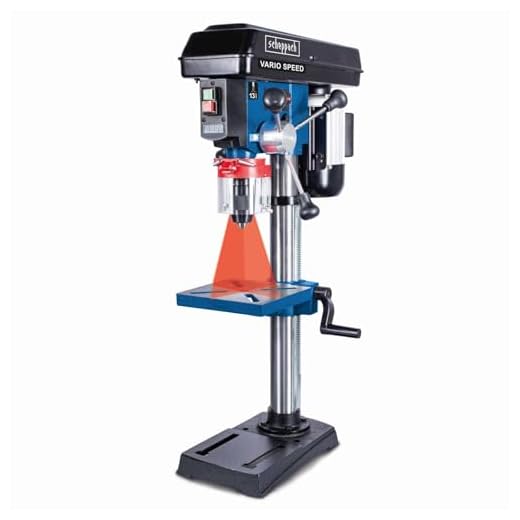
Scheppach DP19Vario Variable-Speed Drill
We appreciate the stepless speed regulation and digital readout which give precise control without changing belts. The solid build and tilting table make it versatile for more demanding woodworking and light metalwork tasks.
If you’re looking for a variable-speed pillar drill that behaves more like a small production machine, this is ideal for workshop users who need precise, tool-free speed adjustment and build stability.
What the stepless control delivers
The DP19Vario uses a stepless (vario) speed system so you can find the exact RPM that best suits the bit and material without opening a belt cover. The digital readout removes guesswork and lets us return to exact settings when switching tasks. At 550 W it offers a good balance between torque and controllable speed for wood, plastics and light steel.
Practical workshop use and things to note
In our tests the machine felt substantial and stable — the weight and build quality reduce chatter and improve hole quality. The included laser and light are useful for quick set-up, although a few users report the laser's adjusters or retainers can be fault-prone; a quick check in assembly addresses most issues. If bench space and a slightly higher budget are acceptable, this model offers a meaningful step up in control and versatility.
We recommend this for semi-serious hobbyists and small workshops that need a flexible, hard-working bench drill with precise speed control.
Einhell TE-BD 750E 750W Pillar Drill
We found the induction motor smooth and quiet, giving consistent torque for tougher drilling jobs. The MK2 quick-change chuck and adjustable table make it flexible for furniture-making, joinery and heavier hobby tasks.
A powerful, durable pillar drill designed for heavier hobby use and light professional work, this model suits serious DIYers and small workshops that need a long-lasting motor and solid table adjustments.
Power and build for heavier tasks
The induction motor runs with lower noise and reduced vibration while delivering steady torque. This makes it easier to drill larger diameters and work through dense timbers without strain.
The MK2 quick-change chuck supports a wide range of bit sizes up to 16 mm, allowing faster tool changes during projects. A height-adjustable table with tilt and swivel functions adds flexibility for angled drilling, awkward pieces, and custom jig setups.
Day-to-day usability and limitations
In daily use we value the machine’s smoothness and stability: it copes well with bench joinery and larger dowel or mortice holes. The built-in light, however, is not as bright as we would like for precision alignment, so we recommend adding focused task lighting for fine work. The unit’s weight and footprint mean it suits a permanent bench or cabinet rather than temporary set-ups.
Overall, this is a practical, well-specified pillar drill that balances power, quiet running and useful table functionality — a sensible choice for those ready to step up from entry-level machines.
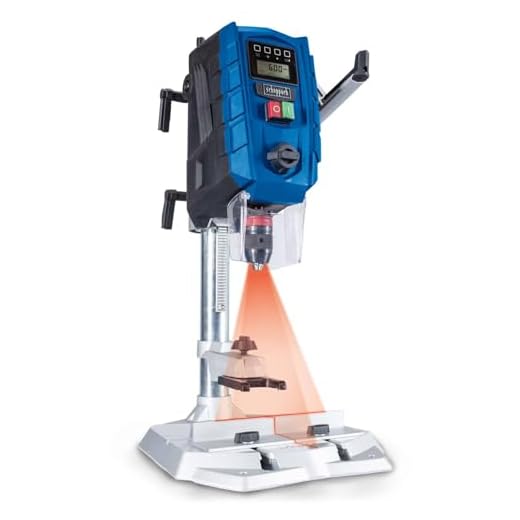
Scheppach DP60 710W Bench Drill
We like its combination of a 710 W motor, digital speed display and compact footprint at a sensible price. It covers most DIY and light model-engineering tasks well, though the laser is only approximate and the finish can be variable.
If you’re looking for an affordable, capable bench drill that gives digital control, this is ideal for hobbyists, model-makers and DIYers who want sensible features without a large outlay.
Why it stands out in its price bracket
The DP60 brings a 710 W motor, digital speed readout and a 13 mm chuck into a compact package that’s easy to place on a home bench. For light metalwork, plastics and woodworking it offers a lot of control: the display allows us to dial speeds appropriate to material and bit size rather than relying on pulley changes.
Real-world use and caveats
In practice it performs very well for small projects and repetitive holes. The laser is useful for rough alignment but not for precision centre-marking — expect about 1–2 mm error unless you rely on the chuck centre directly. Some buyers have reported minor issues with presentation or packaging, and the drill can be noisier than more expensive machines at top speed. For the money, though, it’s a practical, versatile tool.
We recommend this as a pragmatic choice where budget and bench-space matter — you get useful digital controls and good drilling accuracy without breaking the bank.
Clarke CDP5RB 5-Speed Bench Pillar Drill
We found it simple, reliable and well suited to home workshops where space and straightforward operation matter. The five-speed set-up and safety features make it a sensible, affordable choice for everyday woodworking and light metalwork.
If you’re looking for a compact, straightforward bench drill for home use, this is ideal for hobbyists and DIYers who need a dependable machine without complex controls.
Straightforward design and dependable basics
This five-speed pillar drill gives a simple, tried-and-tested pulley-based approach that’s easy to understand and maintain. The 13 mm capacity and B16 spindle taper are standard for many accessory chucks and vices, and the clear chuck guard and no-voltage release switch add welcome safety for novices.
Where it fits in a workshop
We see this model as a workhorse for occasional fabrication and woodworking: it drills consistently with minimal fuss. There are examples of cosmetic shipping damage out of the box, and a light touch of lubrication on the column often improves smoothness, but neither is a deal-breaker. If you plan to bore large holes in hardwood or run long production sessions, a higher-power model is a better fit.
Overall, this is a reliable entry-level pillar drill that does what it promises — a practical machine for the weekend workshop.
Final Thoughts
If you want a single, no-compromise pick for a busy workshop, we recommend the Bosch PBD 40 Digital Bench Drill. It's fast, precise and built for repeatable accuracy — ideal for professional woodworkers, small shops and anyone doing frequent dowelling, mortices or metal-and-wood combos. Its digital readout, quick clamp and reliable depth stop make accurate, repeatable holes straightforward.
For a versatile second choice that blends precision with flexibility, the Scheppach DP19Vario is our top pick. Its stepless speed control and sturdy table make it perfect for advanced hobbyists and small commercial workshops who need fine speed tuning without changing belts. It’s the best balance of control and value for demanding woodworking tasks.
Guide — How we choose a great pillar drill and how to get the most from it
Buying a pillar drill is about matching machine strengths to your workshop tasks. Look first at motor power and speed range: higher wattage gives torque for larger bits, while a wide speed band (or stepless control) lets you match speed to material and bit diameter. Check chuck type (keyed vs quick-change), table size and tilt, build quality and any digital assists like readouts or depth stops. We favour induction-style motors for smooth torque and durability in regular use.
Our picks explained (benefit-led summaries):
Practical tips & tricks for better drilling
Care, maintenance and common mistakes to avoid
Budget vs premium: where to spend
Final usage ideas and alternatives
We hope this helps you choose a pillar drill that matches the work you do. With the right machine, a few good bits and proper setup, you’ll start making cleaner, faster and more reliable holes — and enjoying woodworking more.
FAQ
Digital readouts speed up setup and reduce guesswork when repeating depths or speeds. For professional work where repeatability matters — cabinetry, jigs or production runs — we find the readout pays back its small premium in time saved and fewer mistakes.
Yes — several models here (notably the Bosch PBD 40 and Scheppach DP19Vario) handle light-to-medium metal work. Use the correct drill bits, slower speeds for metal, secure the work, and add cutting fluid for thicker steel. Avoid forcing the bit; consistent feed and correct speed are key.
Keyed chucks hold very securely and are traditional for metalwork. Quick-change or MK2 systems are faster for swapping bits and reaming in woodworking. We prefer quick-change for furniture-making and keyed for heavy-duty metal drilling — choose based on the work you do most.
Very. A tilting and height-adjustable table expands what you can drill — bevel holes, work larger pieces, or use jigs. If you make angled joints or work on assemblies, opt for a model with a tilting table and generous travel.
Lasers are handy for rough alignment but rarely replace a centre punch or proper jig. Treat a laser as a convenience rather than a precision tool — good for quick checks, not for final alignment on critical joinery.
